What Is a Link Indexing Bot? How Automated Indexers Work in 2026
By Joseph C. Lorenzo · Updated August 2026 · 10 min read
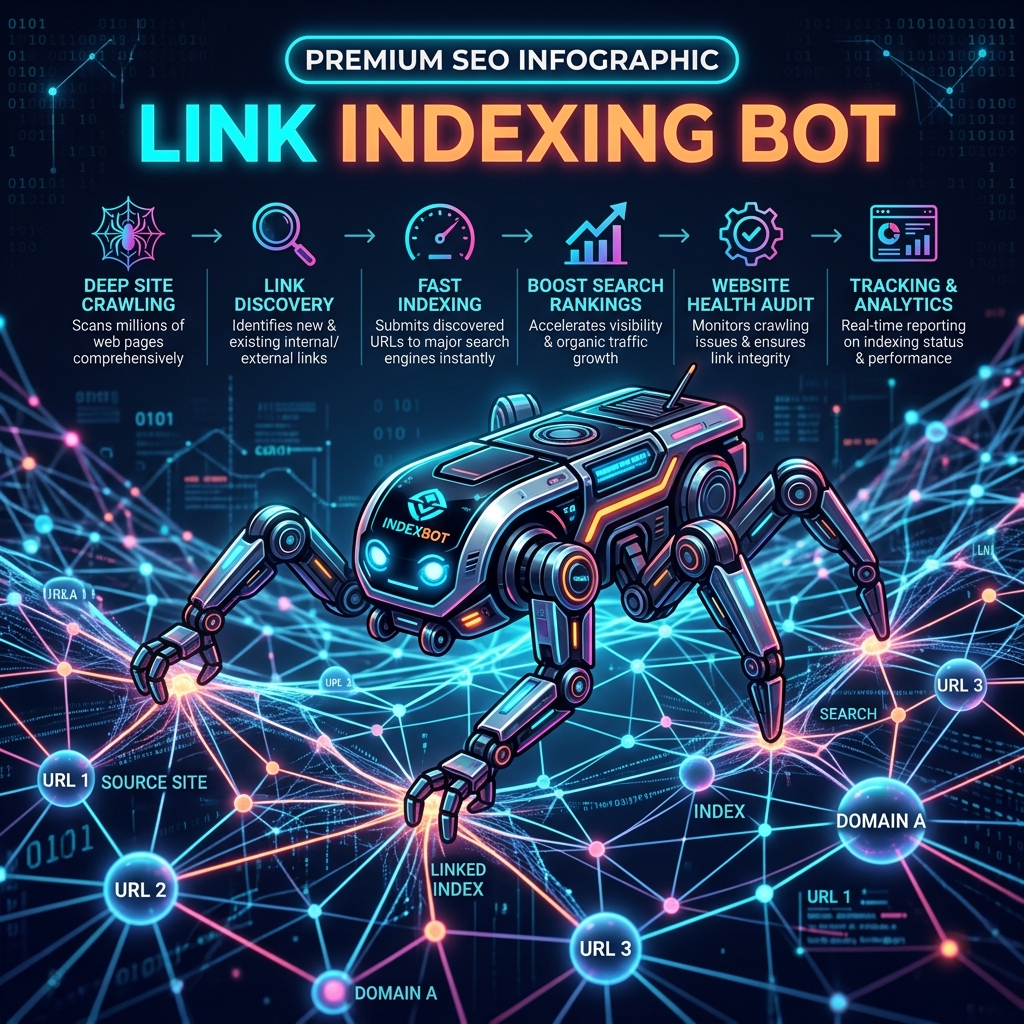
A link indexing bot is an automated system that submits URLs to search engines through official API endpoints, discovery networks, and crawler bait signals — without requiring human intervention per link. In 2026, the distinction between a legitimate indexing automation and spam software has become technically precise. This guide explains exactly how each type works, what separates safe from risky, and what architecture modern indexers use.
The Problem Link Indexing Bots Solve
When you build 200 backlinks in a link-building campaign, you face a critical bottleneck: most of those links will never be discovered by Google naturally in a timeframe that matters. Here's the math:
- 200 Web 2.0 and tier 2 links built over 2 months
- ~50% indexed naturally within 90 days (Google's own crawl priority)
- ~30% indexed after 90+ days
- ~20% never indexed
At this scale, manually processing each unindexed URL through GSC (10–15 requests/day limit) would take 13+ days of continuous work — and you don't own those domains anyway. An indexing bot submits all 200 URLs simultaneously through multiple signal channels in under a minute.
How Modern Link Indexing Bots Work: The Technical Architecture
Layer 1: URL Ingestion & Parsing
You upload a list of URLs (typically a .txt file, one per line). The bot parses the list, validates URL format, deduplicates entries, and classifies each URL by domain authority and type (owned domain vs. third-party). This classification determines which submission method applies.
Layer 2: Google Booster Feed Injection (Owned Domains)
For URLs on domains you own and have verified in Google Search Console, the preferred method is direct Google Indexing API submission. This requires:
- A Google Cloud Project with the Indexing API enabled
- A Service Account with "Owner" verification in GSC for the target property
- OAuth2 JWT token generation for authentication
- A POST request to
https://indexing.googleapis.com/v3/urlNotifications:publish
LinkRaptor handles this pipeline entirely. You add your service account keys once, and the system generates fresh tokens, submits URLs, and tracks quota usage — rotating across multiple service accounts to stay within the 200 URL/day/account limit.
Layer 3: Booster Feed Publication (Third-Party Links)
For third-party URLs you don't own (Web 2.0s, guest posts, forum links), direct Google API submission isn't possible — Google requires property ownership verification. Instead, legitimate indexing bots use crawler bait networks:
- High-authority sitemap feeds: Publishing the URLs into active sitemaps on high-crawl-frequency domains, where Googlebot will discover them on its regular crawl cycles
- RSS/Atom feed injection: Adding URLs to fresh RSS feeds that Googlebot monitors continuously
- WebSub (PubSubHubbub) pings: Notifying Google's own WebSub hub (
pubsubhubbub.appspot.com) of new feed entries containing the target URLs - IndexNow submission: For Bing/Yandex coverage on owned domains
Layer 4: XML-RPC Ping Distribution
The oldest layer — and the one most "link indexing bots" from 2012 exclusively relied on. XML-RPC pings send a standardized notification to blog aggregators and ping servers. In 2026, their effectiveness has declined significantly, but they still provide supplementary signal value when combined with other methods.
LinkRaptor sends parallel XML-RPC pings to active endpoints including Google's blog ping service, Pingomatic, Weblogalot, and FeedBurner aggregators. These are sent concurrently using Promise.all() rather than sequentially, keeping submission time under 2 seconds per URL batch.
Layer 5: Job Tracking & Status Reporting
What separates modern indexing tools from legacy scripts is result tracking. LinkRaptor writes each URL's submission status (queued → submitted → verified) to a database, so you can see:
- Submission timestamp per URL
- Which signal channels were used
- Whether Google has indexed the URL (via index check polling)
- Success/fail per channel
Safe vs. Spam: What Separates Legitimate Bots from Risk
| Characteristic | ✅ Legitimate Bot | ❌ Spam/Risk Bot |
|---|---|---|
| API usage | Official Google/Bing APIs with OAuth | Simulated browser clicks, scraping |
| Signal type | Real crawlable feeds, valid pings | Fake traffic, bot pageviews |
| GSC verification | Requires verified property ownership | Claims to bypass verification |
| Rate compliance | Respects 200 URL/day quota, rotates keys | Claims to submit unlimited URLs to same endpoint |
| Transparency | Shows submission logs and status | Vague "100% success" claims with no proof |
The key red flag: any service claiming to submit thousands of URLs directly to Google's Indexing API on third-party domains without GSC verification is either misrepresenting their method or using techniques that violate Google's terms of service.
What Google Sees vs. What the Bot Does
A common misconception: Google doesn't passively receive a list of URLs from indexing bots and add them to the index. What actually happens:
- Bot publishes a signal: Adds URL to a booster feed, sends a ping, or submits via API
- Signal creates a crawl priority event: Googlebot's scheduler receives a hint that this URL may have new content
- Googlebot crawls the page independently: It fetches the actual URL, renders it, evaluates content quality
- Google decides to index (or not): Based on content quality, duplication, spam signals
The bot speeds up step 2. Steps 3 and 4 remain entirely under Google's control. This is why page quality remains non-negotiable — the bot can get Googlebot to visit, but can't make Google index a low-value page.
How LinkRaptor's Indexing Bot Works in Practice
Here's the step-by-step flow when you submit 100 URLs to LinkRaptor:
- You paste URLs into the dashboard and select indexing methods (Google, Bing/IndexNow, Yandex, Others)
- The system classifies URLs — own domain vs. third-party, checks format validity
- Parallel submission fires: All booster feed injections, WebSub pings, and XML-RPC pings run concurrently via
Promise.allSettled()— all 100 URLs processed within 5 seconds - For owned-domain URLs: If you've added a service account key, the Google Indexing API call goes out simultaneously
- Results logged per URL: Success/fail per channel, timestamp, response codes
- You can check back via the job dashboard to see crawl detection status
Frequently Asked Questions About Link Indexing Bots
Q: Can an indexing bot guarantee my backlinks get indexed?
No tool can guarantee indexation — that decision belongs to Google. What bots guarantee is that your URLs get submitted through multiple discovery channels, maximizing the probability and speed of indexation. For high-quality pages on crawlable domains, submission-to-index rates are typically 70–90% within 72 hours.
Q: Will using a link indexing bot get me penalized?
Using legitimate submission bots that use official APIs and standard discovery signals carries no penalty risk. The penalty risk comes from tools that generate fake traffic to manipulate crawl stats, or that claim to bypass GSC verification — these violate Webmaster Guidelines.
Q: How many URLs can an indexing bot handle?
LinkRaptor processes batches of up to 10,000 URLs per job. The booster feed and ping layers are unlimited by volume. The Google Indexing API layer is quota-bound at 200 URL/day per service account key — so larger campaigns use multiple rotated keys to stay compliant.
Automate Your Backlink Indexing
LinkRaptor's indexing bot handles URL classification, multi-channel submission, key rotation, and result tracking — so you can focus on building links, not managing submission queues.