How to Get Backlinks Indexed Fast in Google (2026 Guide)
By Joseph C. Lorenzo · Updated August 2026 · 11 min read
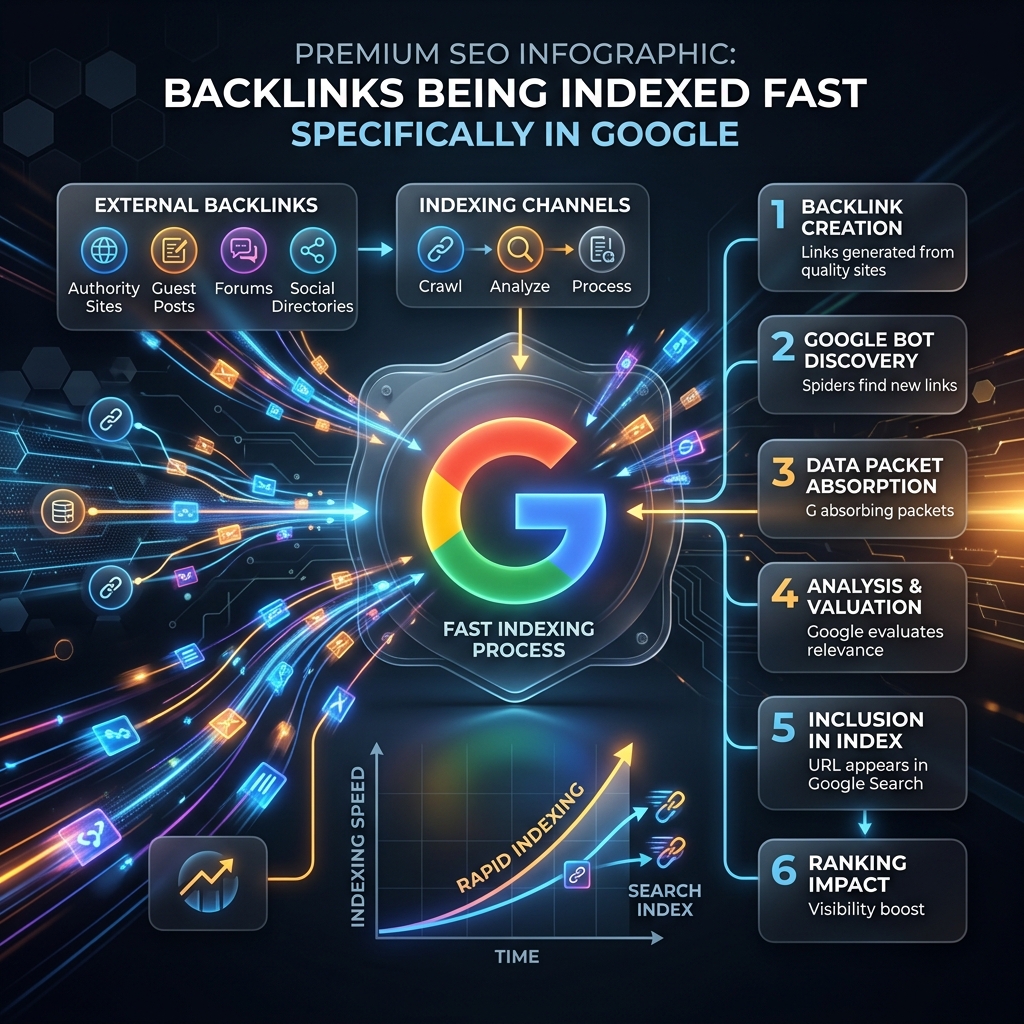
Getting backlinks indexed in Google specifically — not just Bing or Yandex — requires understanding which signals Google actually responds to in 2026. Google does not participate in the IndexNow consortium. It has its own crawl infrastructure, priority signals, and eligibility rules. This guide covers the exact methods that move URLs into Google's crawl queue, with honest assessments of what works and what's marketing fluff.
How Google's Crawl Queue Works (And Why It Matters)
Google maintains a massive, prioritized crawl queue — billions of URLs waiting to be fetched by Googlebot. New URLs enter this queue through discovery signals. The priority of a URL in the queue is determined by:
- Authority signals of the page and domain hosting the URL
- Number of inbound discovery signals pointing to the URL
- Freshness signals — recently published or updated content gets higher priority
- Google's own heuristics based on historical crawl performance
The goal of indexing strategies is to increase both the number and quality of discovery signals pointing to your target URL, moving it from the back of the queue to the front.
Method 1: Google Indexing API (Owned Domains Only)
The most direct path into Google's crawl queue for owned domains. The Google Indexing API allows verified domain owners to submit URLs for priority crawling via an authenticated REST API call. Google has stated this is primarily intended for JobPosting and BroadcastEvent structured data, but SEOs use it for standard pages.
Requirements:
- A Google Cloud Project with the Indexing API enabled
- A Service Account JSON key
- The Service Account email added as an "Owner" in Google Search Console for the target property
- OAuth2 JWT authentication
Default quota: 200 URLs per day per project, resetting at midnight Pacific Time. You can submit a quota increase request via Google Cloud Console, though approval is not guaranteed.
Important: The API is for pages you own and have verified. It cannot be used to submit third-party URLs on domains where you don't have Owner access in GSC. Claims to the contrary are false.
For owned domain URLs submitted through LinkRaptor, we handle the complete API authentication pipeline — you simply add your service account key once, and the system submits your URLs automatically with quota tracking and key rotation.
Method 2: Google Booster Feeds (All URLs, Including Third-Party)
This is the most scalable method for backlink URLs on domains you don't own. A Google booster feed is a high-crawl-frequency sitemap or RSS feed hosted on an authoritative domain. By publishing your target URL into this feed, you create a crawlable path that Googlebot follows during its regular scheduled visits.
The key performance driver is the host domain's crawl frequency. A domain that Googlebot visits multiple times per day means your URL gets discovered within hours of submission. LinkRaptor's booster feed network maintains active crawl signals by publishing fresh content continuously, which preserves Googlebot's regular visit frequency.
This is why results from professional indexing services typically appear within 48–72 hours for quality URLs, compared to weeks or months for passive discovery.
Method 3: WebSub (PubSubHubbub) Pings to Google's Hub
Google operates its own WebSub hub at pubsubhubbub.appspot.com. When you publish a new URL to a WebSub-enabled feed and ping Google's hub, it receives a real-time notification and immediately queues the feed for fetching. This is one of the fastest discovery paths into Google's systems.
The ping is a simple HTTP POST request:
Content-Type: application/x-www-form-urlencoded
hub.mode=publish&hub.url=https://your-feed-url.com/feed.xml
For this to be effective, the feed being pinged must contain (or link to) the URL you want indexed. LinkRaptor adds every submitted URL to active feeds before pinging Google's WebSub hub, ensuring Googlebot has a real crawlable path to follow.
Method 4: Strategic Internal Linking on the Referring Domain
If you control the referring domain (your own Web 2.0, a guest post site where you have access, or a PBN property), internal linking is the highest-value action you can take. Googlebot crawls high-authority pages on each domain visit and follows all links it finds.
When you add 2–3 internal links to the page hosting your backlink from other already-indexed pages on the same domain, you:
- Shorten the crawl path depth, making the target page easier to discover
- Pass internal PageRank to the target page, signaling its importance
- Guarantee that Googlebot encounters the page on its next scheduled crawl of the domain
For Web 2.0 properties: link to your new post from your profile page and any previously indexed posts in the same niche. For guest posts: ensure the site owner links to the post from their homepage or sidebar for the first 2–4 weeks after publishing.
Method 5: High-Authority External Discovery Links
Creating external links to the page hosting your backlink accelerates Googlebot's discovery. The strongest free methods in 2026:
- Reddit: Share the URL in a relevant subreddit with genuine context. Reddit has enormous crawl budget — Googlebot visits it continuously. A legitimate Reddit post gets crawled within hours.
- Twitter/X: Tweets are indexed by Google. Posting the URL creates a crawlable indexed page linking to your target.
- Pinterest pins: Pinterest has high crawl frequency. Pinning an image linking to the target URL creates a indexed crawlable path.
- Medium, Substack: Publishing a brief article referencing the URL creates a high-DA crawlable page pointing to your target.
Important nuance: You're linking to the referring page (the page containing your backlink), not directly to your money site. The goal is to get Googlebot to visit the referring page and discover your backlink from there.
Content Quality: The Non-Negotiable Floor
No indexing method can overcome thin or duplicate content. Google's systems evaluate page quality before making a final indexation decision. A page Googlebot visits but deems low-quality will be placed in a "crawled – not indexed" state — regardless of how many submission signals you send.
For Web 2.0s hosting your backlinks: ensure each post is at least 300–500 words of unique, topically relevant content. Avoid spinning software, keyword-stuffed text, or direct copies of content from other pages. Google's spam algorithms are significantly more sophisticated in 2026 than even two years ago.
The practical benchmark: if the page wouldn't rank on its own merit for any query, it may not get indexed — and your backlink will never be counted.
How to Verify a Backlink Is Indexed in Google
After submitting indexing signals, verify success using:
- Google site: search: Search
site:referringdomain.com/exact-page-url. If the page appears in results, it's indexed. - GSC URL Inspection: If you own the domain, paste the referring URL into GSC for definitive crawl/index status and last crawl timestamp.
- LinkRaptor Dashboard: The job tracking view shows submission status and flags URLs that haven't been discovered after 72 hours, allowing you to resubmit or apply additional signals.
Check 3–5 days after submission for the first verification pass. If still not indexed after 2 weeks, assess the content quality of the referring page before resubmitting.
Common Mistakes That Delay Google Indexation
- Submitting your money site URL instead of the referring page: If your backlink is on webtwopointoh.blogspot.com/post-123, that's the URL to submit — not your-money-site.com.
- Using indexing tools on noindex pages: If the referring page has a noindex meta tag, Google will crawl but explicitly won't index it. Check for noindex before submitting.
- Submitting URLs that return 404 or 301: Validate that each URL returns a 200 HTTP status before submitting to indexing services.
- Ignoring robots.txt blocks: If the referring domain's robots.txt blocks Googlebot, no amount of external signals will get the page indexed.
- Resubmitting without fixing content: If a URL was crawled but not indexed due to thin content, resubmitting without improving the content will produce the same result.
Get Every Backlink Counted by Google
LinkRaptor's indexing pipeline fires all Google-compatible discovery signals simultaneously — booster feeds, WebSub pings, Google API (for owned domains), and XML-RPC networks. Upload your backlinks once and let the system work.