Google Indexing API: The Ultimate Technical SEO Guide
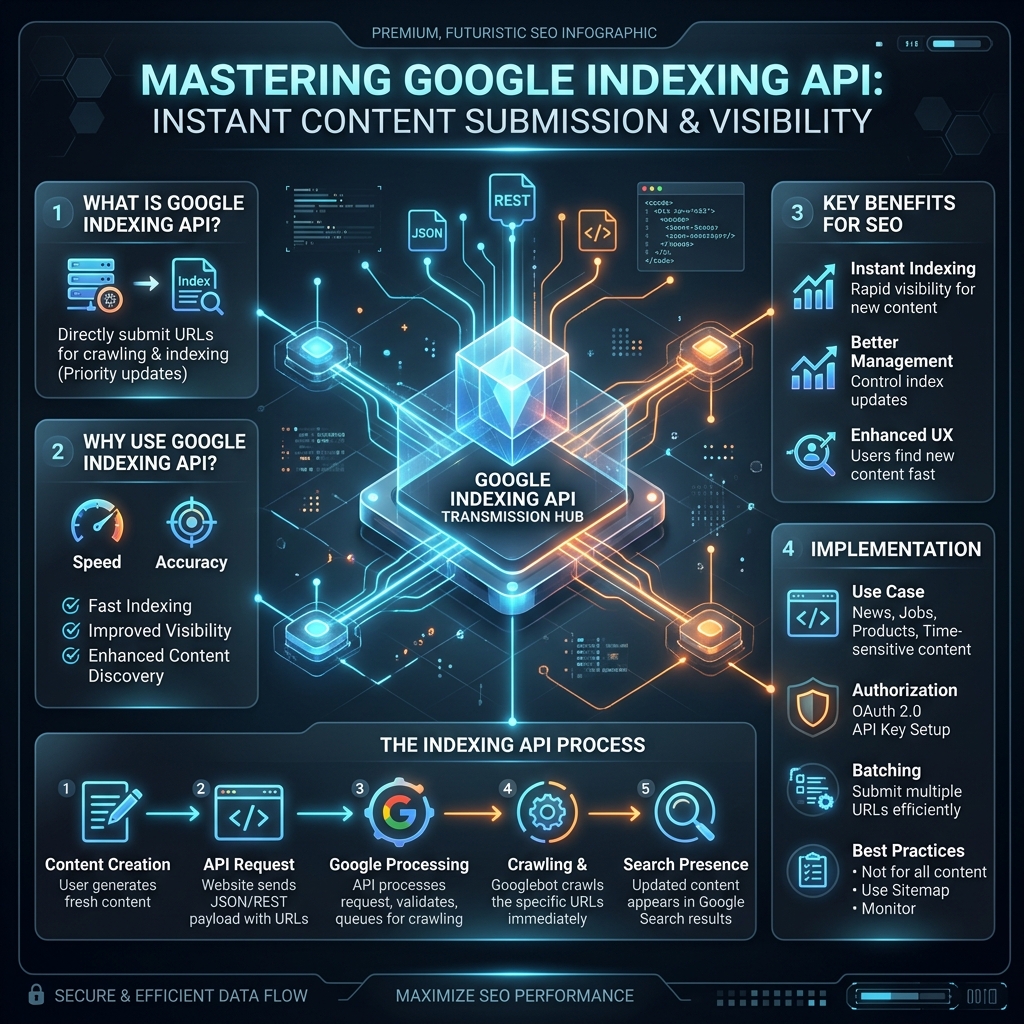
The Google Indexing API is arguably the most potent tool in a modern SEO professional's arsenal. In a landscape where Google’s crawl budget is increasingly constrained and new content often sits in the "Discovered - currently not indexed" bucket for weeks, relying on passive discovery is no longer a viable strategy for high-volume sites. Unlike traditional XML sitemaps, which rely on Googlebot to periodically poll your server on its own schedule, the Indexing API allows you to actively push HTTP POST requests directly to Google’s servers, forcing an almost immediate crawl.
How the Google Indexing API Works Under the Hood
At its core, the Google Indexing API was originally designed for two highly specific use cases: job postings and live stream broadcasting. Because these content types are extremely time-sensitive (a job might close in a day; a live stream happens right now), Google created an infrastructure to bypass the standard crawl queue.
However, SEOs quickly discovered that the API endpoints could accept and process any URL type. When you submit a URL via the API authenticated through a Google Cloud Service Account, Google treats the submission with high priority. In many cases, server logs show Googlebot hitting the target URL within 3 to 5 minutes of the API payload being received.
"Sitemaps are passive suggestions. The Indexing API is a direct command. When you need tiered backlinks indexed rapidly to flow PageRank to your money site, you cannot wait 14 days for a natural crawl. You must force the issue."
— Joseph C. Lorenzo, Founder of LinkRaptor
Core Benefits of API Indexing for Tiered Link Building
If you are running complex tiered link building campaigns, utilizing automated indexers like LinkRaptor that leverage the API is mandatory. Here is why:
- Instant Discovery for Web 2.0s: Most Web 2.0 platforms (like WordPress.com or Blogger) do not have enough domain authority to guarantee deep crawling of new subdomains. Pushing the URLs via API ensures they are seen.
- Crawl Budget Efficiency: By explicitly telling Google which specific URLs were updated, you prevent the crawler from wasting resources traversing pagination or tag pages, reserving your crawl budget for the pages that matter.
- Rapid PageRank Flow: A backlink provides zero value until Google indexes the page it lives on. Faster indexation means faster rankings.
Navigating Limitations and Quotas
While powerful, the API is heavily gated by Google to prevent spam. By default, a standard Google Cloud project is limited to 200 URL submissions per day. For enterprise publishers or SEOs building thousands of links, this is a massive bottleneck. Overcoming this requires sophisticated service account key rotation and pooled API limits.
Deep Dive Technical Guides
To master the Indexing API and scale your backlink indexation, you must understand the technical nuances. Explore our specific guides in this silo:
- Understanding Google Indexing API Quota Limits — Learn how to bypass the 200 URL limit safely.
- Is the Google Indexing API Actually Free? — Breaking down Google Cloud billing and hidden costs.
- How to Setup Google Instant Indexing — The technical implementation guide for developers.
About the Author: Joseph C. Lorenzo
Joseph is a veteran SEO Specialist and the Founder of LinkRaptor. With over a decade of experience in technical SEO, crawl budget optimization, and automated link building architectures, he builds tools that help enterprise brands and affiliate marketers dominate the SERPs.